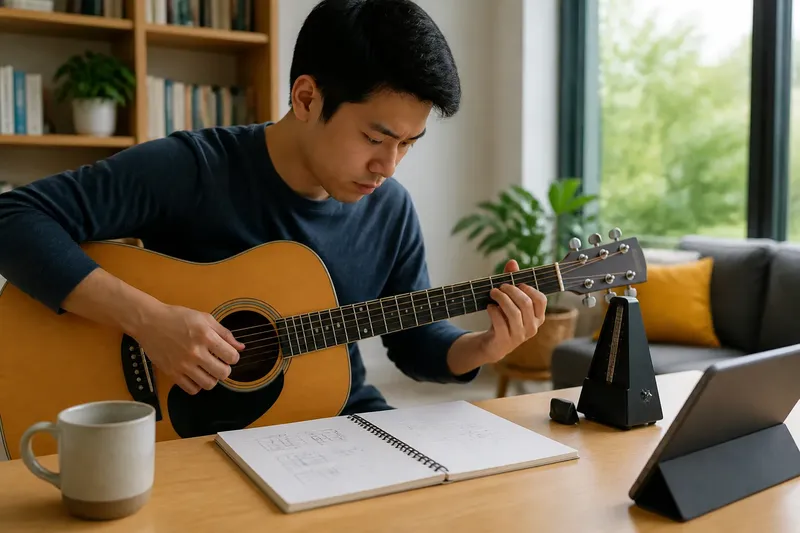
A Ten-Minute Review After a Learning Session
Use a ten-minute review after a learning session to capture what worked, what remains unclear and what to practise next, without turning notes into a scorecard.
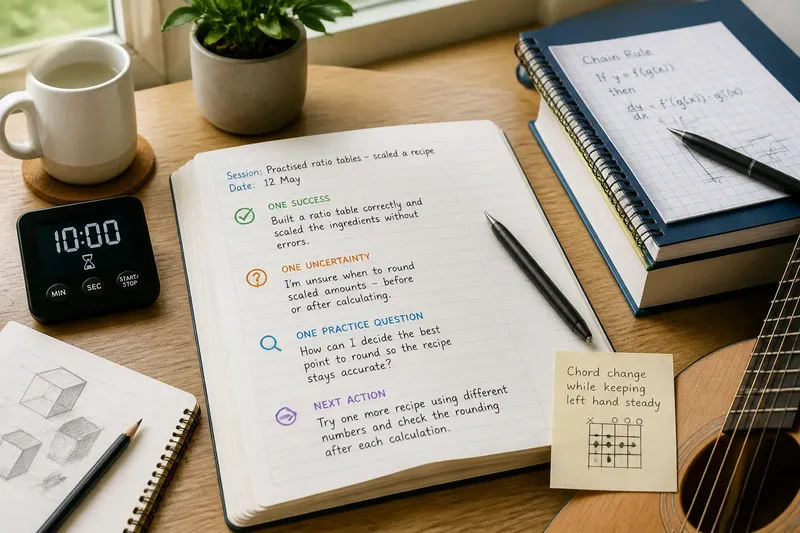
You close the notebook after a drawing lesson, leave the spreadsheet open after a tutorial or put down the guitar and wonder what to practise next. A ten-minute review after a learning session gives that pause a modest job: record one clear success, one uncertainty and one question for your next practice. Ten minutes is the limit, not a quota; the note can be finished sooner.
Keep a page, note or document for these entries. A quiet timer can help, but it is there to mark the boundary, not to create another performance target. The prompts below offer a route through the review. Use only the ones that fit the session, and leave the rest blank rather than manufacturing an insight.
Name the session before judging it
Write down what you worked on and what the task asked you to do. “Practised ratios” is broad; “used a ratio table to scale a recipe” identifies an action. If you followed a lesson, note the relevant exercise or section. If you worked independently, name the problem you chose.
This description gives the rest of the review a setting. A success in a guided exercise may not mean the same thing as a success while working from memory. Neither is inherently better; the distinction matters when you decide what to try next.
Say you spent a session learning to format a spreadsheet table. Record “made a table with a header row and sorted the entries” rather than “did spreadsheets”. Later, you can identify the skill without reconstructing the afternoon from a file called “Practice final new”.
Write the task in one line. You are making a reference, not a memoir.
Record one success you can point to
Choose one thing that worked, then describe what you did or noticed. “I understood the lesson” is hard to inspect. “I kept the left hand steady while changing the chord” gives you an observable action. So does “I checked the units before substituting values” or “I asked a clarifying question before drafting the reply.”
A success need not be polished or complete. It might be a correct first attempt, a sensible correction or a useful decision to slow down. The point is to identify a behaviour that contributed to progress, rather than award yourself a broad label such as “good at this”. Labels are tidy, but they do not tell you what to repeat.
Keep the wording specific enough that you could recognise the action in a later session. “I paused and counted the rhythm aloud when I lost the beat” is more useful than “I was focused”. If no success stands out, record what you attempted. Starting a difficult exercise is an observable event, even if the result needs work.
One concrete success gives you something to carry forward without turning the note into praise or criticism.
Mark one uncertainty without trying to settle it
Write down the part that remains unclear, difficult to choose or easy to confuse. Keep it to one point. “I do not know why this method works” may be a starting point, but narrow it if you can: “I am unsure when to use the chain rule rather than expand the expression first.”
Uncertainty is information about where your understanding is still thin. Avoid forcing an answer just to make the page look complete. If you guessed, say so. If two explanations seem plausible, note the difference you cannot yet resolve.
For a practical skill, uncertainty can concern sequence, sensation or judgement. You might know how to make a basic stitch but not how tightly to hold the yarn at a corner. You might follow a recipe but remain unsure how much browning is enough before adding the next ingredient. Describe what you noticed; do not turn the note into a diagnosis of your ability.
A useful uncertainty is small enough to revisit and clear enough not to sprawl across the whole subject.
Turn the uncertainty into a practice question
Write one question that could guide your next attempt. It should point towards an action or observation, not demand a grand explanation. “Can I keep the stitch tension even while turning the corner?” is easier to use than “How do I become better at knitting?”
A practice question can ask you to compare two choices, notice a cue or repeat a task while attending to one feature. It does not promise that the answer will appear in the next session. It gives you somewhere to look, which is more useful than returning to the same exercise on autopilot.
In the spreadsheet session, the note might read: “I sorted the table correctly when the header row was recognised. Next time, how can I tell that the header is excluded before sorting?” That question names a check to make. It also connects the next session to the uncertainty instead of assigning the vague task “practise spreadsheets more”.
Phrase the question so you could try to answer it through practice, observation or a targeted explanation.
Choose a next action small enough to begin
Turn the question into a starting action. Select one exercise, find the relevant page in your notes, prepare the materials or decide what feature to watch. This is not a full practice plan. It is a first move that reduces the friction of reopening the work.
Imagine you have just practised explaining a science idea and noticed that the middle of your explanation became muddled. Write the question, “Which part loses its thread when I explain this without notes?” Then choose the action: explain the same idea once while listening for the point where you hesitate. The observable result is a specific place to revisit, or a clearer explanation with no obvious break. Either way, you have a next decision: practise that section or move on to another question.
If your question concerns a software shortcut, the next action could be to open a practice file and try the shortcut on one suitable task. Keep the action tied to the question, rather than adding an unrelated goal because the blank page looks too empty.
You may not know when the next session will happen. Record an action that will still make sense when you return. “Try the shortcut on the sample file” is kinder to your future self than “continue”.
Leave yourself a starting point, not a contract.
Keep evidence separate from the scorecard
A reflection note is useful when it describes what happened. It becomes less useful when every session receives a mark, rank or verdict. A score can tempt you to compare unlike tasks, reward an easy session over a difficult one or treat a temporary struggle as a fixed measure of ability.
You can notice change without grading yourself. Compare descriptions across sessions: did you need a prompt, catch an error earlier or make a decision with less hesitation? These are clues that can help you choose an appropriate next practice question, not formal measurements.
If you keep a learning log, make the entries easy to scan. A date and a short task label may be enough. There is no need to decorate the page with streaks, elaborate colour codes or a chart that demands weekly maintenance. The record should serve the practice, not quietly acquire a practice of its own.
Keep the evidence plain. Plain notes are less likely to audition for management.
Adjust the review to the session you had
Some sessions produce a clear success and uncertainty. Others are interrupted, mostly administrative or spent reviewing familiar material. Do not invent a dramatic insight to satisfy the format. Write what is true: “No new task today; corrected the labels in my notes,” or “Stopped before the exercise because the instructions were unclear.”
When a session is interrupted, record where you stopped and what you will need to resume. When you watch a demonstration, note the move or decision you want to try yourself. When you practise with another person, record one piece of feedback you want to examine rather than copying every comment into the review.
Different learning formats leave different traces. A video may make a sequence visible; a discussion may surface a question; solo practice may reveal a recurring hesitation. The same prompts can still help, provided you describe the session you actually had rather than the one you meant to have.
- Observation: you can name the task and the action you attempted. If so, write that action in one line; if not, record the material or prompt you used instead.
- Observation: one behaviour worked, such as checking units before calculating. If so, note what you did; if not, record the attempt you made rather than inventing a success.
- Observation: one point remains unclear. If so, phrase it as a single uncertainty; if not, leave that prompt blank and do not manufacture a problem.
- Observation: the uncertainty can be explored through a specific action. If so, write a practice question and a starting task; if not, note what explanation or example you need before practising.
- Observation: the session was interrupted. If so, write where you stopped and what would let you resume; if not, record the next useful action without adding a reminder you do not need.
- Observation: the review is complete before the timer ends. If so, stop; if not, finish the most useful note and leave lower-priority prompts blank rather than treating the remaining time as an assignment.
If ten minutes is more than the session warrants, finish sooner. The routine is a container, not a quota.
What should you do when the review feels awkward?
Do I need to write after every learning session?
No. Use the review when a session leaves something worth carrying forward or when you want a clearer starting point next time. If the notes become repetitive, shorten them or pause the routine until it is useful again.
What if I cannot identify a success?
Record one action you attempted, such as beginning an unfamiliar task or noticing where an error occurred. If nothing stands out, say that plainly and use an uncertainty or question to guide the note.
Should I review immediately or later?
Either can work. Writing soon after practice may preserve small details, while a later note may help you describe what still feels unclear; choose the timing that makes your account more accurate.
How do I use the notes in my next session?
Read the last practice question and choose a small action that lets you investigate it. Keep the earlier success in view as a behaviour to repeat, not a standard you must reproduce perfectly.
Let the note point back to the work
A ten-minute review after a learning session earns its place when it makes the next practice easier to enter. One specific success shows what may be worth repeating; one honest uncertainty tells you where to look; one practice question gives that attention a direction. Keep the record brief enough to return to, and leave room for the answer to change as your understanding does.
At the next session, begin with the question you wrote, then let the work revise it. The ten-minute review after a learning session is useful when it sends you back to the skill, rather than persuading you to spend the afternoon improving the note.